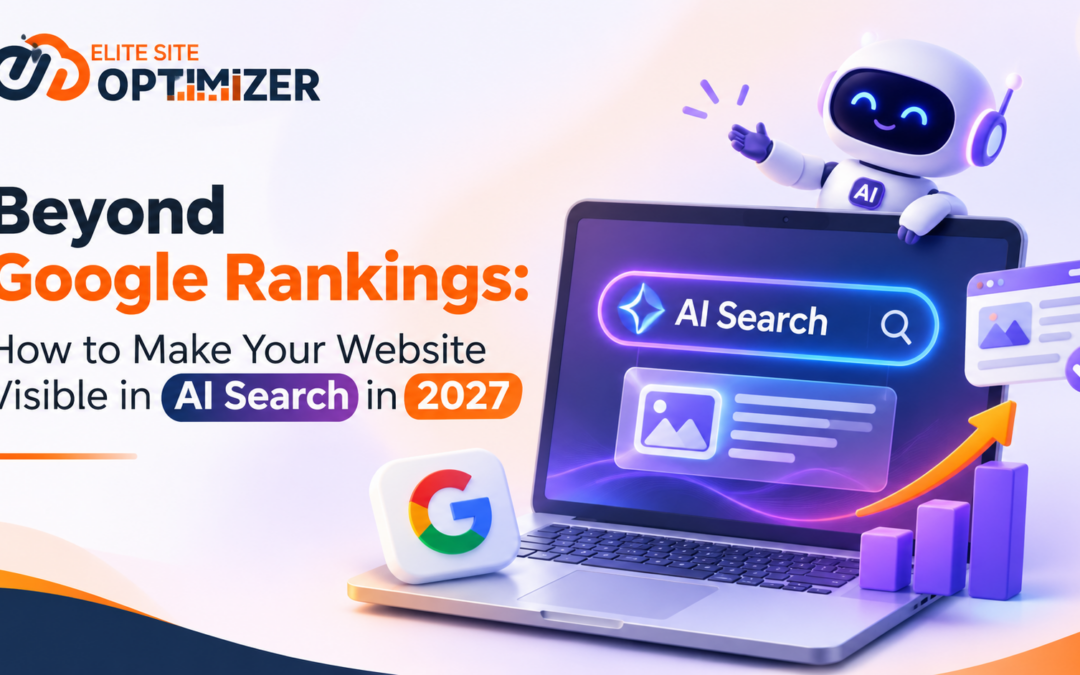
Google rankings remain valuable, but your visibility strategy for 2027 should also consider how customers discover information through AI-generated answers. A potential buyer may ask an assistant to compare services, explain a technical problem, or explore solutions before visiting a company website.
For businesses, this creates an additional question: can your website contribute useful, reliable information to those answers?
AI search optimization helps you address that question. It combines technical access, clear content, credible evidence, and ongoing measurement. The goal is to make your website easier to discover, understand, and reference while giving visitors a reason to explore your business.
This guide provides a practical plan for 2027 based on guidance available today. Platform features may change, and no optimization method guarantees an AI citation.
What Is AI Search Optimization?
AI search optimization is the practice of improving a website so its content can be discovered, understood, and potentially referenced in AI-powered search experiences.
Alongside keyword rankings, businesses should examine whether relevant AI answers mention their brand, cite their pages, and describe their services accurately.
These outcomes mean different things:
| Outcome | What it tells you |
| Brand mention | An answer names your business |
| Website citation | An answer identifies your website as a source |
| Referral visit | Someone clicks through to your website |
| Conversion | A visitor completes an action, such as submitting an inquiry |
Google states that its AI Overviews and AI Mode do not require special optimization beyond established SEO practices. Your AI search strategy should strengthen those foundations. developers.google.com
Why AI Readiness Matters for 2027?
AI readiness describes how prepared your website is for discovery and interpretation by AI powered search systems. It is a useful audit framework rather than a universal certification used by every platform.
A readiness review asks practical questions:
- Can relevant crawlers access important pages?
- Is essential information available as readable text?
- Do headings explain what each section covers?
- Are claims supported by evidence?
- Does the website clearly identify the business behind the content?
An audit helps uncover weaknesses you can address. Actual visibility still needs to be measured through observed answers and citations. A strong audit score alone does not establish that your business appears in customer searches.
For a practical starting point, follow this 30-minute AI readiness audit guide to review content structure, technical accessibility, and opportunities to improve your website’s readiness for AI-powered discovery.
1. Build Content Around Customer Questions
Start with the questions customers ask when researching a problem or choosing a provider.
Use sales conversations, support requests, website searches, and search performance data to identify topics that deserve clearer answers.
For a website optimization business, useful questions might include:
- Why does my website rank on Google but rarely appear in AI answers?
- What should an AI readiness audit include?
- How can I track whether AI platforms cite my website?
- Which technical issues should I fix first?
Map each question to an existing page before creating another article. Sometimes the most useful improvement is a stronger service description, a comparison table, or a practical example added to an established page.
Choose topics connected to your expertise and the services customers can actually buy.
2. Remove Technical Barriers to Discovery
Helpful content needs to be accessible before it can contribute to search experiences.
Review priority pages for indexing restrictions, broken links, incorrect canonical tags, server errors, and access problems caused by firewall settings. Check whether important content becomes available only after a login, click, or other interaction.
Keep internal links working and maintain an accurate XML sitemap. When essential information depends on JavaScript, inspect the rendered page to confirm that the content is accessible.
For Google’s AI search features, a page must be indexed and eligible to appear with a snippet. These conditions establish eligibility; they do not guarantee selection. developers.google.com
Review other platforms’ current crawler documentation before making access decisions. Search access and model-training permissions may involve different controls.
3. Answer Questions Clearly and Completely
Organize each page around what the reader needs to understand. Applying Answer Engine Optimization (AEO) principles can help make content clearer, more structured, and easier for search engines and AI-powered platforms to interpret.
Understanding the relationship between Answer Engine Optimization and Generative Engine Optimization can also help businesses structure content for direct answers while providing the depth and context needed for AI-generated responses.
Use descriptive headings and give a direct answer before introducing supporting details. For example, a section titled “What does an AI readiness audit check?” could begin:
An AI readiness audit reviews technical access, page structure, content clarity, and supporting information to identify barriers to discovery and interpretation.
Follow that explanation with examples, limitations, and next steps.
Use numbered instructions for processes and tables for comparisons. Keep terminology consistent so readers can follow the explanation without interpreting several names for the same feature.
Avoid stretching a straightforward answer to meet an arbitrary word count. Give the subject enough depth to be useful.
4. Add Evidence That Makes Your Content Worth Referencing
Generic advice gives readers little reason to choose your page as a source.
Strengthen your content with information your business can substantiate, such as:
- Documented case studies.
- Original research with a clear methodology.
- Annotated examples.
- Expert explanations.
- Practical testing procedures.
If you publish results, explain the scope, measurement period, and limitations.
For example, a case study could describe which technical issues a team found, what it changed, and what happened afterward. Distinguish observed improvements from assumptions about what caused them.
Identify authors or reviewers where relevant, link to reliable references, and update information when facts change. These practices help readers assess your work.
5. Make Your Business Easy to Understand
Your website should clearly explain who you serve, what you offer, and where you operate. Improving Website Visibility in AI Search starts with presenting accurate, consistent, and well-structured business information that both visitors and AI-powered search platforms can understand.
Review your homepage, service pages, About page, and contact information together. Check whether they describe the same business consistently.
A useful service page should explain:
- The customer problem it addresses.
- What the service includes.
- Who it is suitable for.
- Relevant capabilities and limitations.
- What the customer should do next.
Connect service pages with related guides and case studies through descriptive internal links. Each page should have a distinct purpose and help readers explore the subject further.
Clear business information also gives you a reliable reference when checking whether AI-generated descriptions of your company are accurate.
6. Use Structured Data Accurately
Structured data should describe the content and business information actually visible on a page.
Depending on the page, Organization, Article, Product, or Local Business markup may be appropriate. Validate the implementation and correct inaccurate or outdated properties.
Google does not require special AI schema or new AI text files for inclusion in its AI search features. Treat structured data as part of sound technical maintenance, without promises of automatic citations. developers.google.com
7. Build Relevant Visibility Beyond Your Website
Create opportunities for people to discover and verify your expertise outside your own domain. Building a credible presence across relevant external platforms can support AI Search Visibility by making your business information and expertise easier to discover and reference.
Contribute useful commentary to industry publications, participate in relevant professional discussions, and maintain accurate business and partner profiles.
Choose these activities because they reach the right audience and provide useful information. For example, a detailed explanation of a common technical problem can demonstrate your expertise and attract interested visitors.
Assess the relevance and accuracy of external coverage alongside referral quality. Counting mentions or backlinks alone will tell you little about whether the activity helps potential customers understand your business.
8. Measure AI Visibility Alongside Business Results
Create a manageable set of prompts representing your customers’ research and buying questions.
For each test, record the platform, date, exact prompt, and available settings. Review:
- Whether your brand appears.
- Which website pages receive citations.
- How your products or services are described.
- Which competitors and external sources appear.
- Whether the answer contains inaccurate information.
Repeat tests over time. Treat each response as an observation rather than a complete measure of your market visibility.
Keep brand mentions, linked citations, referral visits, and conversions separate. Where referral information is available, use analytics to understand what visitors do after arriving.
To strengthen your monitoring process, use an AI citation checklist to review content clarity, structured data, brand consistency, and the factors that may help your website become a useful source for AI-generated answers.
An optional “How did you hear about us?” fields can also help identify discoveries that analytics misses.
Use these findings to guide improvements. An inaccurate company description may call for clearer business information. A missing explanation may reveal an opportunity to improve a service page or publish a useful guide.
How Elite Site Optimizer Supports AI Search Optimization
Elite Site Optimizer provides tools for assessing website readiness and monitoring AI visibility.
Its AI Readiness audit reviews areas including crawlability, semantic structure, content clarity, structured data, and page rendering. These checks help teams identify issues to investigate and prioritize.
ESO’s AI Citation Report supports visibility monitoring across Chat GPT, Gemini, Claude, and Perplexity, including citation trends and competitor presence. Its broader website optimization features include content analysis, technical site analysis, schema analysis, performance analysis, and link checking.
A practical workflow is to audit priority pages, address the findings, validate the changes, and monitor observed visibility over time.
Use readiness findings to guide improvements and citation reporting to assess what appears in the monitored responses.
Prepare Your Website for AI Discovery in 2027
Start with the pages most closely connected to customer decisions. Remove access barriers, answer important questions clearly, support claims with evidence, and explain your business consistently.
Then measure whether your content is being referenced and whether that visibility contributes to qualified visits, inquiries, or sales.
Not sure how prepared your website is for AI-powered search? Connect with Elite Site Optimizer to explore your website’s AI readiness, identify optimization opportunities, and take the next step toward improving your visibility in AI search.
Ready to improve your website’s search performance?
Sign up for Elite Site Optimizer and start analyzing your website’s SEO, accessibility, performance and content quality.
Start Your Free Signup